
Workplace productivity is often treated as an individual responsibility. We tend to believe that a team’s output depends on how motivated, focused, and “energized” each employee shows up to work on a given day. In this view, productivity is something people bring with them.
But what if productivity is not primarily an individual trait? What if it is shaped by the environment employees work in, rather than by personal effort alone? Recent employee productivity statistics suggest that output is strongly influenced by conditions outside an individual’s direct control.
Research shows that productivity is a system-level outcome. Factors such as how work is organized, how teams communicate, how managers set priorities, and how tools are implemented all have a measurable impact on performance. Even small design choices can either support or undermine focused work.
From workflow structure and communication platforms to management models, AI adoption, and yes – even the physical workspace itself, including something as simple as a plant in the hallway – every element contributes to how productive a workplace really is. The latest workplace productivity statistics explain why output is not just about effort, but also about how work is designed.
Key workplace productivity statistics
Pssst… consider this part as a little trigger warning for workplace reality.
These workplace productivity stats expose patterns most organizations feel, but rarely name out loud. They’re not dramatic or sensational – just quietly uncomfortable in the way honest data often is.
Look closer, and the numbers begin to explain why sustained focus and meaningful progress feel harder than they should, even inside the strongest teams.
Here’s what current work productivity data shows when the facts are placed side by side:
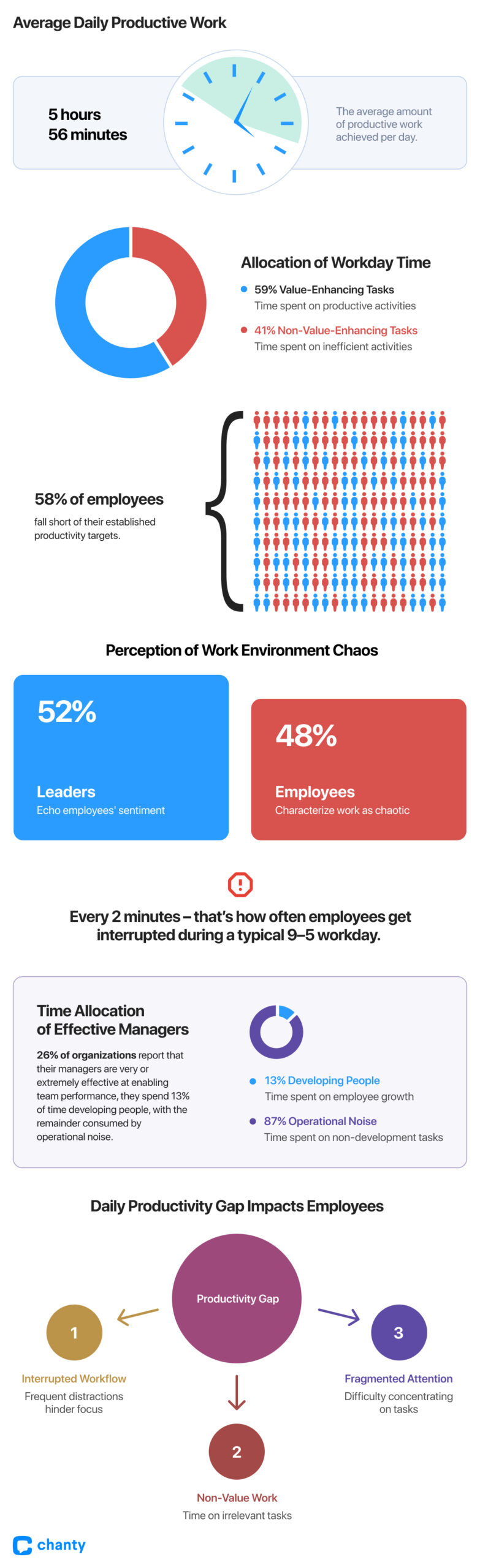
- 5 hours 56 minutes – the average amount of productive work achieved per day. Productivity Lab’s Workforce Utilization Benchmarks 2H show that most organizations target closer to 6 hours 50 minutes, leaving a built-in gap that appears before the day even begins.
- 58% of employees fall short of their established productivity targets. According to the same Productivity Lab research, this shortfall reflects structural constraints more than individual effort or motivation.
- Every 2 minutes – that’s how often employees are interrupted during a typical 9–5 workday. Microsoft’s Work Trend Index 2025 translates this into roughly 275 interruptions per person, per day, driven by meetings, emails, messages, and constant context switching.
- 41% of the workday is spent on tasks that employees say don’t meaningfully contribute to organizational value. Deloitte’s 2025 Global Human Capital Trends highlights how much time is absorbed by coordination, rework, and low-impact activity.
- 48% of employees describe their work as chaotic and fragmented – a perception shared by 52% of leaders. This experience isn’t confined to specific roles or teams; it reflects a broader organizational pattern.
- 26% of organizations report that their managers are very or extremely effective at enabling team performance. Deloitte’s data adds context here: managers estimate they spend just 13% of their time developing people, with the remainder consumed by operational noise.
- 54 minutes – nearly a full hour – represents the average daily productivity gap per employee. This time isn’t lost to inactivity; it’s dispersed across interruptions, non-value work, and fragmented attention.
Taken together, these workplace productivity statistics don’t point to laziness or lack of discipline. They reveal a work environment where productive time is steadily eroded – not dramatically, but persistently – by the way modern work is designed and managed.
Work fragmentation: the core productive constraint
If modern workplaces feel scattered, it’s not accidental. Fragmentation has become the default operating mode. Employees are pulled into meetings, chat pings, and group notifications every few minutes, making sustained focus the exception rather than the norm. Nearly half of employees describe their work as chaotic – a perception shared by leaders as well.
This isn’t an attention problem. It’s environmental problem.
What drives fragmentation
Fragmentation doesn’t come from one dramatic disruption. It builds quietly, through dozens of small demands competing for attention throughout the day. The most common drivers include:
- Unplanned meetings and toxic “always available” expectations
- Digital tool sprawl – bouncing between chat, project management, and documentation apps – fragments focus. Platforms that combine these workflows, such as Chanty, can quietly take some of the chaos off your plate.
- Little or no protected time for focused, uninterrupted work
Meetings play a particularly large role. Roughly 60% of meetings are ad hoc, often spilling into early mornings, lunch breaks, or evenings. Instead of enabling coordination, they compress the already limited time for deep, value-creating work.
Collaboration has expanded dramatically in modern workplaces, but focus has declined in parallel:
- Collaboration time: +27%
- Multitasking: +5%
- Focus efficiency: down from 65% to 62%
- Length of deep-focus sessions: -8%
Collaboration itself isn’t the problem. Productivity suffers when collaboration lacks structure – when every decision requires synchronous alignment, and asynchronous work is underused. Only 22% of organizations report being effective at simplifying work, leaving most teams without clear norms around meetings, decision rights, or response expectations.
How fragmentation translates into a loss of productivity
You already can see the cost of fragmentation in real workplace productivity stats:
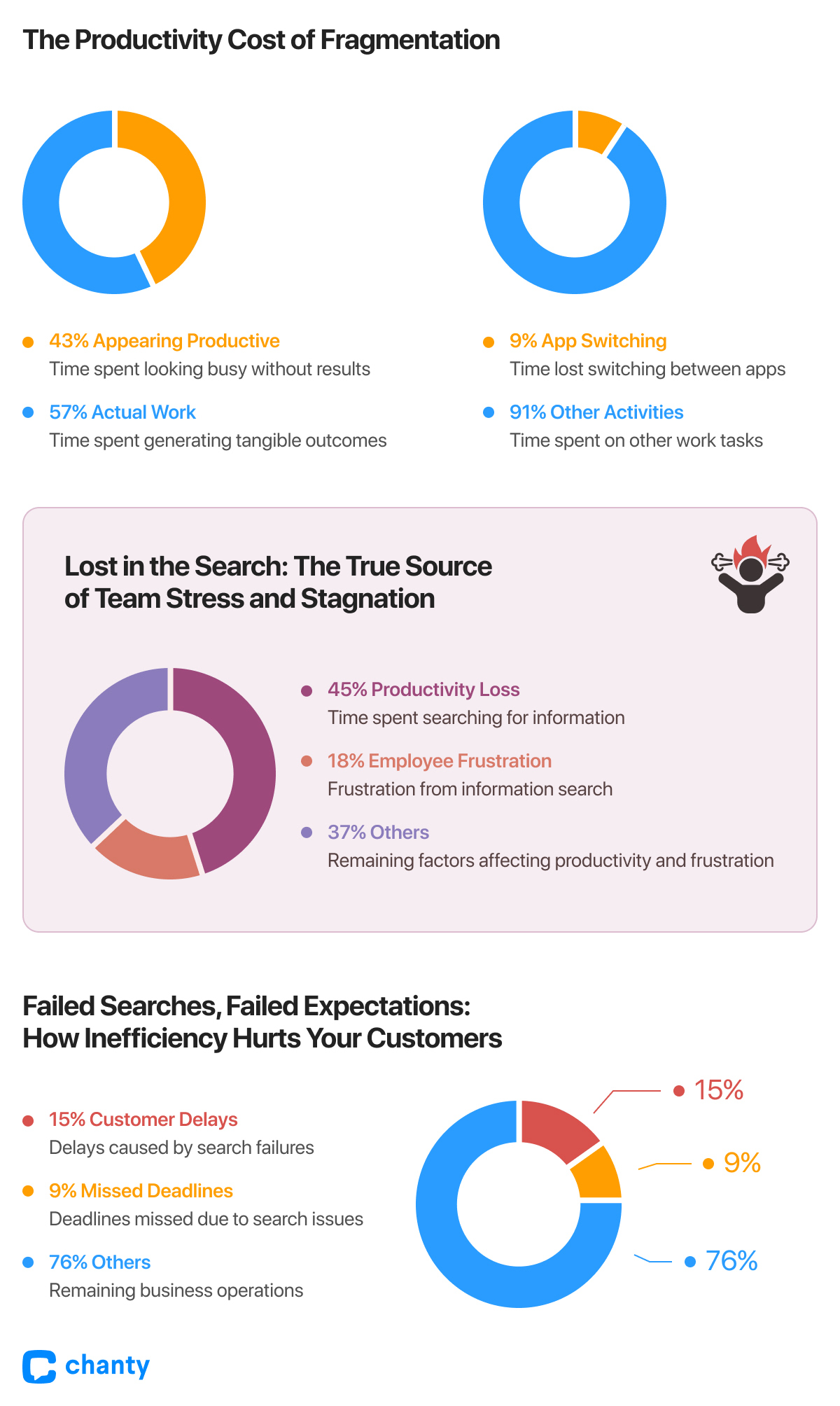
- 43% of employees spend more than 10 hours per week trying to look productive, instead of producing meaningful outcomes (Deloitte 2025).
- The average worker spends nearly 200 hours per year, or 9% of their working time, simply switching between apps.
- 45% of productivity loss and 18% of employee frustration come from searching for information alone (Slite Enterprise Search Survey Report 2025).
- Search failures have real consequences: 15% lead to customer delays, 9% to missed deadlines, impacting revenue and relationships.
So, when you connect the dots, it’s easy to see that fragmentation doesn’t just slow work – it reshapes it. Employees spend more time coordinating, searching, and signaling progress than producing outcomes. Adding yet another focus tool to this fractured system is like placing tape on shattered glass and wondering why it still leaks.
A glimmer of hope
Identifying fragmentation and collaboration misalignment is the first step toward reclaiming focus. Seeing the patterns in workplace productivity statistics allows organizations to make informed choices about how work is structured, rather than simply working around chaos.
Today’s workplaces are more connected than ever, yet employees feel pulled in a dozen directions at once. But understanding the system gives teams the chance to tame the productivity drain monsters, even before adding another tool or app.
Missed productivity targets and the cost of inefficiency
Even the most capable employees can fall short of productivity targets. They show up, work hard, and still lose time to factors beyond their control. According to Productivity Lab, on average, workers miss 54 minutes of productive time per day – meaning organizations are paying full compensation for only about 87% of expected output. These figures are reflected in recent workplace productivity statistics, showing that the problem is systemic, not personal.
This isn’t about laziness or effort. It’s about how work is organized, prioritized, and measured. Overloaded schedules, unclear priorities, and incentive systems that reward activity over outcomes quietly chip away at organizational performance. When work is fragmented and collaboration lacks structure, even star performers struggle to meet targets – a reality highlighted in key employee productivity statistics.
The measurable impact
- Daily output: Under six hours of productive work on average
- Annual cost: $2.86 billion in lost value across tracked organizations (Productivity Lab, 2H 2025)
- Root cause: Often system misalignment, not employee effort
The financial side isn’t just a number on a spreadsheet. ADP’s People at Work 2025 report shows that employees who feel underpaid are less engaged, less resilient, less trusting of leadership, and more likely to quit. For organizations, this translates into higher turnover, added recruitment costs, and missed strategic opportunities.
At the same time, research from Humanities and Social Sciences Communications suggests that fair compensation and thoughtful reward systems do more than satisfy paychecks – they motivate teams and strengthen overall performance. These are essential insights if you’re tracking productivity stats across your teams.
Even high performers can hit limits
Even exceptional employees can hit productivity ceilings when the system is misaligned. They care about results, push themselves hard, and still fall behind. Too often, management only notices the gaps when the metrics turn red – long after the early signals were already there.
Recognizing these hidden costs is the first step toward addressing productivity drains – in ways that support employees instead of piling on more pressure. Understanding how fragmented work, misaligned priorities, and inefficient collaboration quietly erode output helps organizations take smarter action before the next crisis shows up in red ink.
Management as the brain of workplace productivity
Workplace productivity doesn’t live in tools, calendars, or dashboards. It lives in coordination. And coordination, in any organization, happens through management.
If employees are the muscles of the workplace, managers are the brain. They interpret signals, set direction, prioritize effort, and decide what deserves attention. When that “brain” is overloaded, underprepared, or misaligned, even the strongest teams struggle to move in the right direction. Many workplace productivity statistics quietly reflect this dynamic.
When the brain lacks clarity, the body moves – but not forward
Gallup’s research shows that fewer than half of employees clearly understand what’s expected of them. In neurological terms, that’s a broken signal. The body keeps moving, but the instructions are fuzzy – a common issue in productivity in the workplace.
In this environment, productivity shifts away from outcomes and toward motion:
- responding quickly instead of thinking deeply
- showing activity instead of delivering results
- attending meetings instead of advancing work
Deloitte’s analysis of performance management explains why this happens. Systems that emphasize visible activity and outputs encourage busywork – not because people want to waste time, but because they’re trying to prove value in the absence of clear direction. Many employee productivity statistics trace performance loss back to this exact pattern.
The quiet risk of blind guidance
There’s an old idea that the blind cannot lead the blind – not as a judgment, but as a warning about systems without sight.
Deloitte’s research into the role of managers shows that 36% don’t feel prepared for the people-management side of their role, and 36% say they lack technology that truly supports them. When managers themselves lack visibility, clarity, or support, guidance becomes reactive. Teams don’t stop working – they just start drifting, a recurring theme in productivity in workplace data.
And yet, managers remain one of the strongest productivity multipliers. Deloitte’s 2025 survey found that 67% of employees say their manager knows best what motivates them. The most effective productivity gains don’t come from systems alone; they emerge in one-on-one moments where priorities are clarified and effort is aligned.
Productivity needs meaning to last
Atlassian frames productivity not as pressure, but as meaningful progress. When people understand their goals, feel ownership of their work, and see opportunities to grow, productivity improves naturally – and retention follows.
This helps explain why productivity problems often surface later as disengagement or turnover. Working hard without direction drains energy. Motion without meaning doesn’t scale.
What the statistics are really telling us
Taken together, workplace productivity statistics suggest something simple but often ignored: productivity rises when management can see clearly, think structurally, and lead deliberately.
Management isn’t oversight. It is orientation. When the “brain” of the organization is aligned, effort compounds. When it isn’t, even brilliant teams burn energy moving in circles.
Work models shape productivity – structure decides the outcome
Flexibility improves workplace productivity, but only when it is designed as a system, not granted as a perk.
Across multiple productivity in the workplace statistics, one pattern repeats: location itself is neutral. What actually changes performance is how predictable, coordinated, and intentional the workplace structure is.
Employee productivity statistics show that remote and hybrid models often deliver equal or better results – but only when teams operate with shared rules instead of individual improvisation.
What the data reveals:
- Remote-only workers average 29 more productive minutes per day
- 69% of managers report stable or improved productivity in hybrid teams
- Employees with high flexibility are 2.5× more likely to say their workplace supports productivity
Yet presence alone doesn’t solve performance issues. According to Gensler’s Global Workplace Survey 2025, employees now spend 55% of their week in the office, but say they need closer to 65% to perform at their best. Even more telling: only 26% strongly agree that their current workplace helps them do their best work.
In other words, people have returned – but productivity hasn’t fully followed.
Flexibility works when the workplace thinks collectively
The most effective work models treat flexibility as an organizational agreement, not an individual decision.
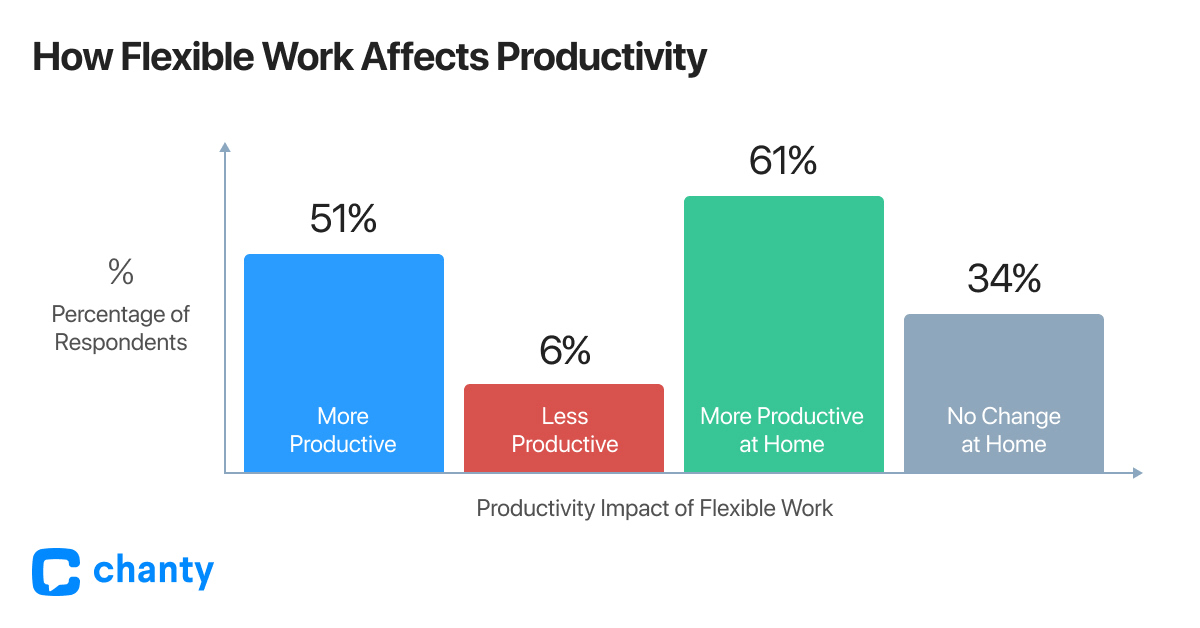
Owl Labs research consistently shows that workers feel more productive with flexible arrangements:
- 51% say their working style makes them more productive
- Only 6% report lower productivity
- 61% say they are more productive working from home, while 34% report no change (Bospar)
But unstructured flexibility creates friction. Hybrid workplaces perform best when teams, not individuals, define:
- availability windows
- collaboration hours
- in-office rhythms
This is why predictability – not location – becomes the core productivity lever.
Emerging models like microshifting reflect this shift in thinking. Instead of fixed hours, work is organized in short, intentional blocks aligned with energy and responsibilities. In 2025, 65% of employees expressed interest in this approach – not because it removes structure, but because it replaces rigid schedules with smarter ones.
Productivity follows workplace design, not ideology
One of the clearest workplace productivity statistics trends is this: employees choose work models deliberately.
- 87.9% rate their productivity as high when given location flexibility, compared to 22.3% in office-only setups
- 78.3% say work arrangement influences job decisions
- 55% of remote workers chose their employer specifically because of remote options
- Even office-first employees are intentional: 84.2% chose that setup consciously
Interestingly, teams that combine remote work with occasional office presence show the strongest results. In these hybrid-but-coordinated environments, 70.6% of respondents rate team productivity as high – slightly outperforming fully remote teams.
The takeaway is structural, not philosophical: Productivity scales when the workplace operates as a coherent system.
Flexibility without coordination leads to noise. Structure without flexibility leads to stagnation. The most productive workplaces balance both – and make those rules visible, shared, and predictable.
AI in the workplace: productivity gains, with conditions
AI has entered the workplace like a second brain – fast, tireless, and very literal. Leadership sees acceleration; employees feel pressure. Both are responding to the same shift, but from opposite ends of the nervous system. The real question isn’t whether AI improves productivity – it’s when it does, and when it quietly makes things worse.
The problem: speed without structure
Most organizations introduce AI as an add-on, not as a redesign. It’s like strapping a turbo engine onto a car with misaligned wheels: speed increases, but wobble comes with it.
Common friction points include:
- AI layered onto existing, fragmented workflows rather than restructuring them
- Employees expected to produce more rather than work better
- Tools deployed faster than norms, training, or boundaries can keep up
The result is predictable. According to Deloitte’s Human Capital Trends, 77% of employees report that AI has increased their workload, and 61% associate it with higher burnout rather than relief. Faster execution doesn’t automatically mean less work – if expectations expand to fill every saved minute, productivity gains simply turn into pressure.
What AI can actually do
When integrated thoughtfully, AI can accelerate routine, knowledge-heavy, or semi-structured tasks. Productivity statistics show:
- Task completion time drops by 12–16% with AI support
- Writing, summarizing, editing, translating, and coding tasks see productivity gains between 5–25%, depending on the role (OECD, 2025)
- Individuals using AI produced solutions as balanced as cross-functional teams working without AI, effectively replicating collective knowledge
- Microsoft WorkLab found 93% of Copilot users reported clearer thinking and reduced effort on root-cause analysis
- At scale, equipping 1,000 employees with AI tools can match the productivity of adding 120 new employees
But these gains come with conditions: AI is not a replacement for judgment or coordination. The risk is clear – when AI begins directing work, employees show lower care, weaker ownership, and reduced accuracy (Deloitte). Speed replaces judgment; outputs grow, but outcomes blur.
AI amplifies the system, not the individual
AI isn’t a silver bullet. Its effectiveness depends on integration, boundaries, and human oversight. Organizations see real productivity gains when:
- Managers define where AI-driven speed adds value – and where it can quietly harm focus or quality
- Expectations don’t automatically rise just because tasks can be done faster
- Human judgment remains responsible for priorities, trade-offs, and final decisions
In other words, AI is a mirror. It reflects the strengths and weaknesses of the system it enters. Added to a structured, clear, and well-coordinated workplace, it frees time for creative and complex work, reduces burnout, and multiplies output. Added to a fragmented, misaligned system, it amplifies chaos, stress, and inefficiency.
The key takeaway: AI doesn’t fix broken systems – it reveals them. Productivity gains follow not from access to tools, but from the intelligence with which those tools are integrated into the workplace ecosystem.
Training and skills: the quiet productivity multiplier
“I know that I know nothing.”
Socrates wasn’t talking about upskilling programs, but he might as well have been.
Work doesn’t stand still. Tools evolve, roles blur, expectations shift. Hiring experienced professionals solves today’s problems – but without learning, even the strongest performers eventually stagnate. Productivity doesn’t collapse overnight. It slowly dries out.
This is where training quietly changes the equation.
Workplace productivity statistics consistently show that learning is not a perk – it’s infrastructure. Employees who receive training are more than three times as likely to describe themselves as highly productive. Not because they work longer hours, but because they work with confidence, clarity, and momentum.
The gap, however, is striking:
- Only 3.8% of workers learn new skills on the job within two years
- Just 1 in 4 employees feels confident they have the skills to advance
- At the same time, over half of leaders say they plan to increase investment in rapid skill development
The demand for growth exists. The supply often doesn’t.
Training matters even more at the management level. Gallup research shows that ongoing manager development increases manager wellbeing by 32%. When training is combined with active encouragement, thriving jumps to 50% – a reminder that learning needs both structure and support.
A workplace isn’t a finished structure; it’s a living system, and even the healthiest plants need water to flourish. You can hire strong roots, but without nourishment in the form of learning and growth opportunities, their productivity would slow, hit a ceiling, and eventually begin to fade.
Wrapping up the workplace productivity story
Workplace productivity isn’t about asking employees to sprint faster – it’s about designing a system where focus, flow, and growth can actually happen. Look closely at the numbers, and a pattern emerges: it’s the workplace itself, not the people, that sets the pace. Fragmented days, scattered tools, unclear priorities, and chaotic collaboration quietly steal time, while thoughtful management, structured flexibility, AI, and ongoing learning turn that same environment into a powerhouse.
The statistics tell the truth:
- Fragmentation steals focus: constant interruptions, unplanned meetings, and digital tool sprawl leave employees juggling coordination instead of creating.
- Management is the brain of the workplace: leaders who set clear priorities, guide teams effectively, and nurture development multiply the results of every team member.
- Flexible work thrives with structure: hybrid and remote models improve output when shared norms define availability, collaboration, and focus.
- AI is a tool, not a replacement: integrated thoughtfully, it can speed task completion by 12–16% and enhance output quality, but it cannot replace human judgment.
- Training nourishes growth: employees and managers who continuously learn stay motivated, productive, and loyal; neglecting skill development limits the potential of the whole system.
And here’s the key insight: when productivity dips, resist the urge to blame or replace employees. Take a step back and examine the environment. Often, it’s not the people who are failing – it’s the system quietly working against them. Fragmented workflows, unclear priorities, and misaligned expectations chip away at output long before anyone notices. When organizations invest in clarity, structure, and support, productivity doesn’t just return – it multiplies naturally, without burning out the very people who make it possible.